
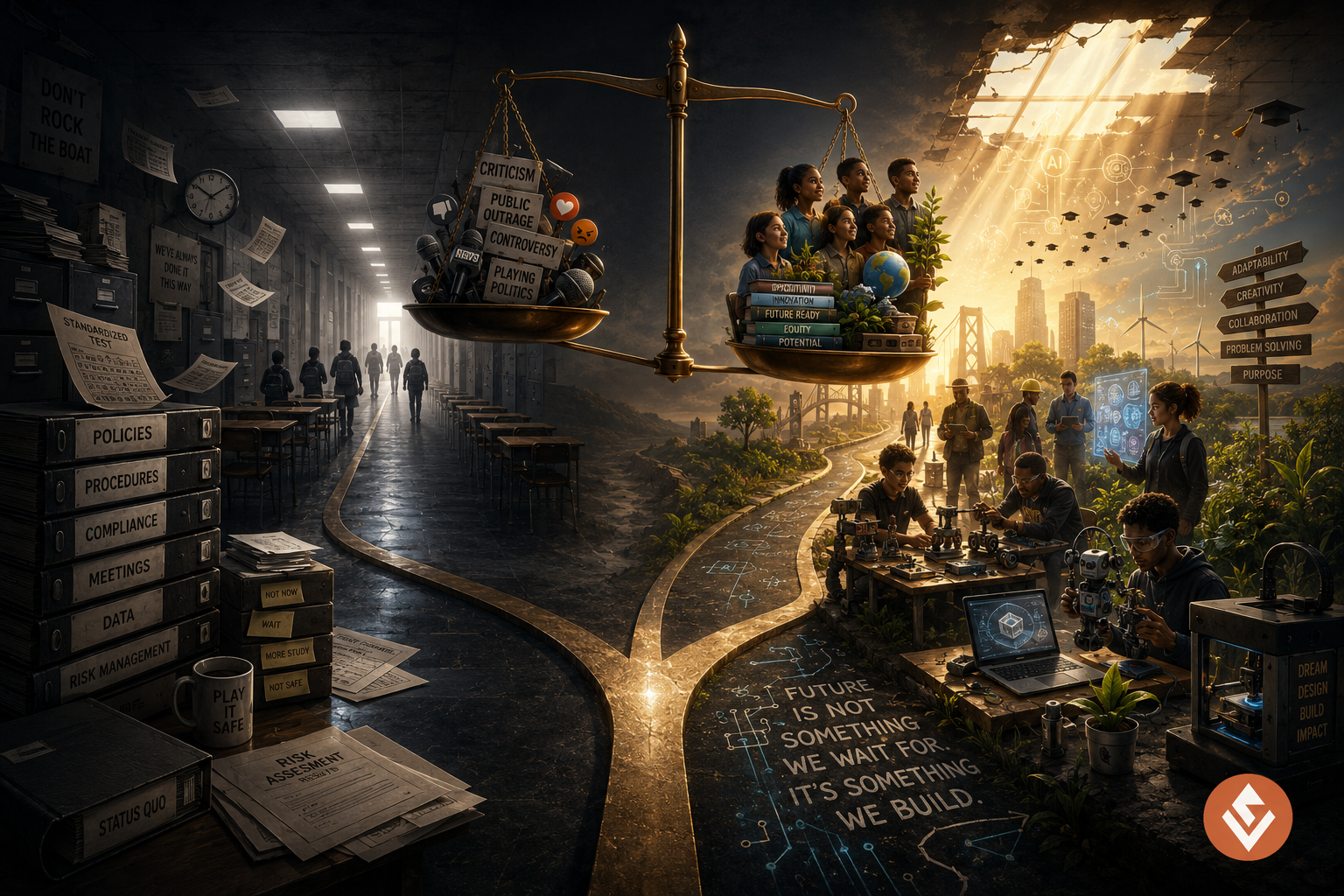


Why Fear Is Quietly Driving Educational Decision-Making
There is a question I have been wrestling with for quite some time:
How many decisions are being made in education because they are right for students—and how many are being made because they are safe for adults?
This is not a comfortable question.
But it may be the most important questions facing public education today.
As leaders, we often speak about innovation, transformation, student-centered learning, future readiness, and preparing young people for a world that is changing at an unprecedented pace.
Yet despite our rhetoric, many of our decisions remain remarkably cautious.
Incremental.
Predictable.
Safe.
Not because we lack vision.
Not because we lack talented educators.
Not because we lack ideas.
But because fear has quietly become one of the most influential forces shaping educational decision-making.
And the cost of that fear is far greater than we often acknowledge.
Fear Rarely Announces Itself
The challenge with fear is that it rarely introduces itself as fear.
Instead, it disguises itself as prudence.
Patience.
Process.
Tradition.
Consensus-building.
Data gathering.
Further study.
Sometimes those things are necessary.
Sometimes they are wise.
But sometimes they become convenient hiding places for our reluctance to act.
We tell ourselves we need more information.
More stakeholder feedback.
More pilot programs.
More time.
Meanwhile, students continue moving through systems designed for a world that no longer exists.
The World Is Changing Faster Than Schools
Artificial intelligence is transforming industries.
Technology is redefining work.
Employers increasingly value adaptability, creativity, collaboration, and problem solving.
Entire career fields are emerging while others are disappearing.
Yet many schools remain organized around structures that have changed very little in decades.
Not because educators do not understand what is happening.
Most do.
Not because leaders lack awareness.
Most don’t.
But because meaningful change inevitably creates discomfort.
And discomfort creates resistance.
The reality is that preparing students for the future often requires adults to let go of the past.
That is where things become difficult.
The Decisions We Avoid
Throughout my career, I have observed something interesting.
The decisions that generate the most anxiety are often the ones that matter most.
The difficult conversation about grading practices.
The redesign of learning experiences.
The shift toward career-connected learning.
The integration of emerging technologies.
The reallocation of resources.
The elimination of programs that no longer produce meaningful outcomes.
The challenge is not that leaders do not recognize these issues.
The challenge is that addressing them often comes with risk.
Someone may disagree.
Someone may complain.
Someone may criticize.
And in today’s environment, criticism travels faster and farther than ever before.
The Political Reality
This challenge has become even more pronounced as education has increasingly become entangled in political and cultural conflict.
Every decision can become a headline.
Every initiative can become a controversy.
Every change can become a debate.
As a result, many leaders find themselves balancing two competing responsibilities:
The responsibility to lead.
And the responsibility to survive.
That tension is real.
Every superintendent understands it.
Every principal feels it.
Every board member encounters it.
The temptation is to avoid decisions that might create conflict.
To wait.
To defer.
To maintain the status quo.
And while that may reduce immediate discomfort, it often creates long-term consequences.
Because avoiding difficult decisions does not eliminate challenges.
It simply postpones them.
The Students Cannot Wait
What concerns me most is that students do not have the luxury of waiting for adults to become comfortable.
The world they are entering is changing now.
Not five years from now.
Not ten years from now.
Now.
Every year we spend debating whether change is necessary is a year students lose opportunities to develop the skills, experiences, and mindsets they need for the future.
This is particularly true for students who have historically had limited access to:
- advanced learning opportunities
- career-connected experiences
- emerging technologies
- authentic problem-solving experiences
Playing it safe rarely creates greater equity.
In many cases, it reinforces existing inequities.
The Courage Leadership Requires
Leadership has never been about avoiding criticism.
Leadership has always required courage.
Not recklessness.
Not arrogance.
Not ignoring stakeholders.
Courage.
The courage to make decisions that serve students even when those decisions are unpopular.
The courage to challenge systems that no longer align with the realities students face.
The courage to acknowledge that what worked yesterday may not be sufficient tomorrow.
The courage to lead with vision rather than fear.
This is particularly important for superintendents.
Because the communities we serve often look to us not simply to manage the present, but to help them imagine the future.
And futures are rarely built by people who are primarily focused on avoiding risk.
The Hidden Cost
The hidden cost of playing it safe is not simply delayed innovation.
It is lost opportunity.
Lost potential.
Lost momentum.
Lost preparation.
Lost time.
Time is the one resource our students can never recover.
Every graduating class gets one chance to experience our schools.
One chance to be prepared for the world they inherit.
One chance to benefit from the decisions we make today.
When viewed through that lens, the question becomes much more urgent.
What opportunities are we unintentionally withholding because we are afraid of the discomfort that change might create?
A Final Reflection
I understand the pressures facing educational leaders.
I understand the scrutiny.
The politics.
The criticism.
The competing expectations.
I have lived them.
But I also know this:
History rarely remembers the leaders who protected the status quo.
History remembers the leaders who had the courage to imagine something better.
As we prepare for another school year, perhaps the most important question we can ask ourselves is not:
“What is the safest decision?”
But rather:
“What decision best serves the future our students will inherit?”
Because the future is coming whether schools are ready or not.
And the greatest risk we face may not be moving too quickly.
It may be moving too slowly because we were afraid to move at all.
