
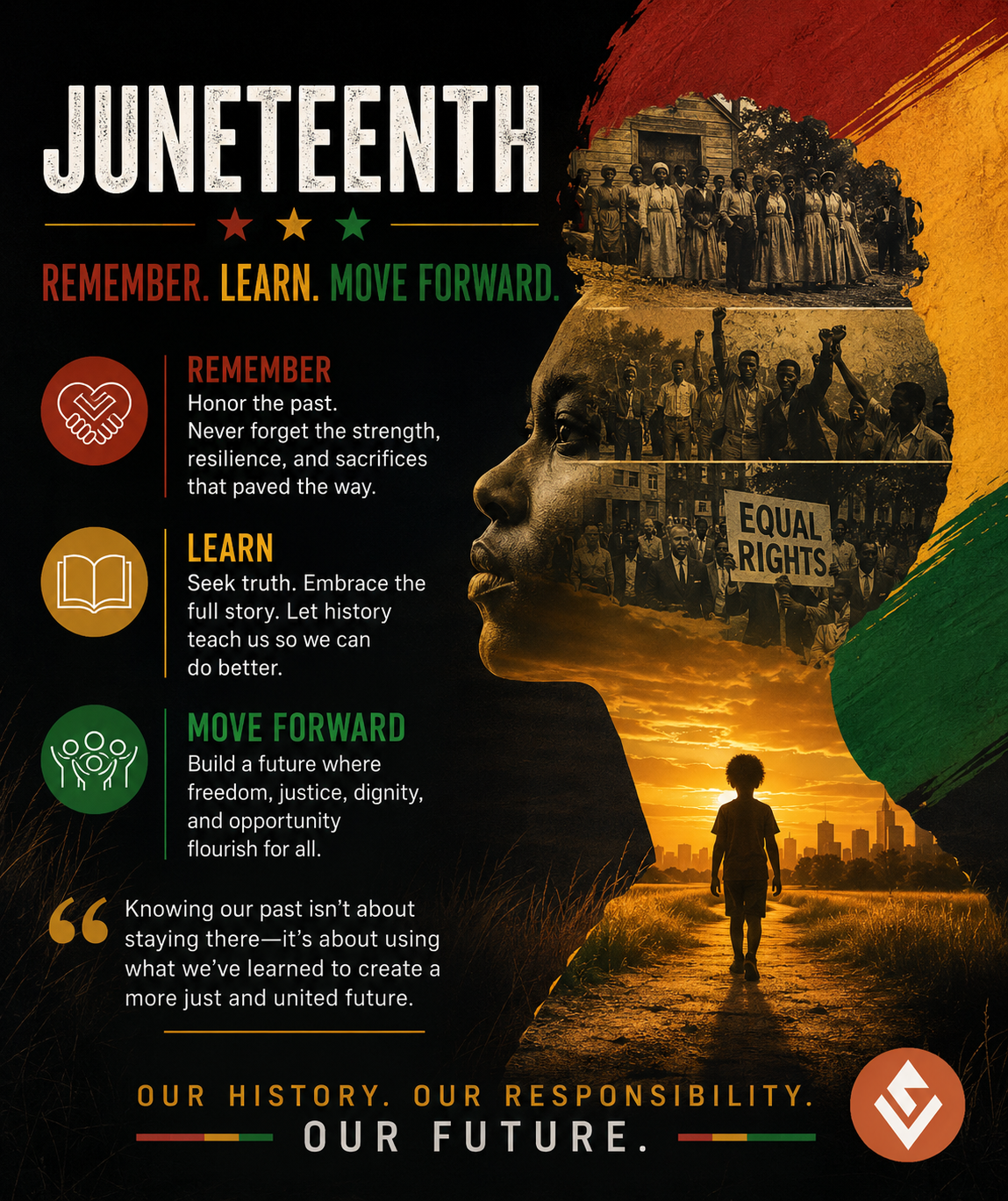


On June 19, 1865, more than two years after the Emancipation Proclamation was signed, enslaved African Americans in Galveston, Texas finally learned they were free.
It is a date that reminds us that freedom and the realization of freedom are not always the same thing.
Juneteenth is not simply a celebration of a historical event. It is an invitation to remember. To reflect. To learn. To wrestle honestly with the complexity of our nation’s story.
As America approaches its 250th anniversary, we find ourselves living through a moment marked by deep political division, competing narratives about our history, growing distrust of institutions, and increasing discomfort with difficult conversations about race, equity, and opportunity. In times such as these, it can be tempting to look away from the past. To simplify it. To sanitize it. Or to weaponize it.
But history is neither a burden to escape nor a weapon to wield.
It is a teacher.
Juneteenth reminds us that progress has never been automatic. Every expansion of freedom, every extension of opportunity, and every advancement toward a more just society has required courage, sacrifice, persistence, and an unwavering belief that America could become more closely aligned with its highest touted ideals.
It also reminds us that unfinished work is not failed work.
The story of Black Americans is, in many ways, the story of America itself—a story of resilience in the face of unimaginable adversity, of communities built despite exclusion, of innovation despite barriers, and of hope despite disappointment.
To learn this history is not to diminish America.
It is to understand America.
To know the stories of those who waited for freedom, fought for civil rights, built schools and churches, challenged injustice, and expanded democracy is to gain a fuller understanding of who we are and who we can become.
That is why history matters.
Not because it tells us what to think.
But because it helps us understand how we arrived here.
For educators, this responsibility is especially important. Schools are among the few places where young people can engage thoughtfully with the past, examine multiple perspectives, and develop the critical thinking skills necessary to navigate an increasingly complex world.
For leaders, Juneteenth is a reminder that progress requires truth. Sustainable change requires understanding. And unity cannot be built upon collective amnesia.
For all of us, Juneteenth offers an opportunity to ask a simple but profound question:
What do we owe future generations?
Surely part of the answer is honesty.
Honesty about our triumphs.
Honesty about our failures.
Honesty about the distance we have traveled and the distance that remains.
The goal is not guilt.
The goal is growth.
The goal is not division.
The goal is understanding.
And the goal is not merely to celebrate freedom as an historical achievement, but to continually expand the conditions that allow freedom, dignity, opportunity, and belonging to flourish for everyone.
This Juneteenth, may we honor those who came before us by refusing to forget.
May we learn from our past without becoming trapped by it.
May we tell the truth even when it is uncomfortable.
And may we continue the work of building a nation that more fully reflects the promise it has always proclaimed.
Because history is not only about where we have been.
It is also about where we choose to go next.
Happy Juneteenth.
May remembrance inspire wisdom, and may wisdom inspire action.
