
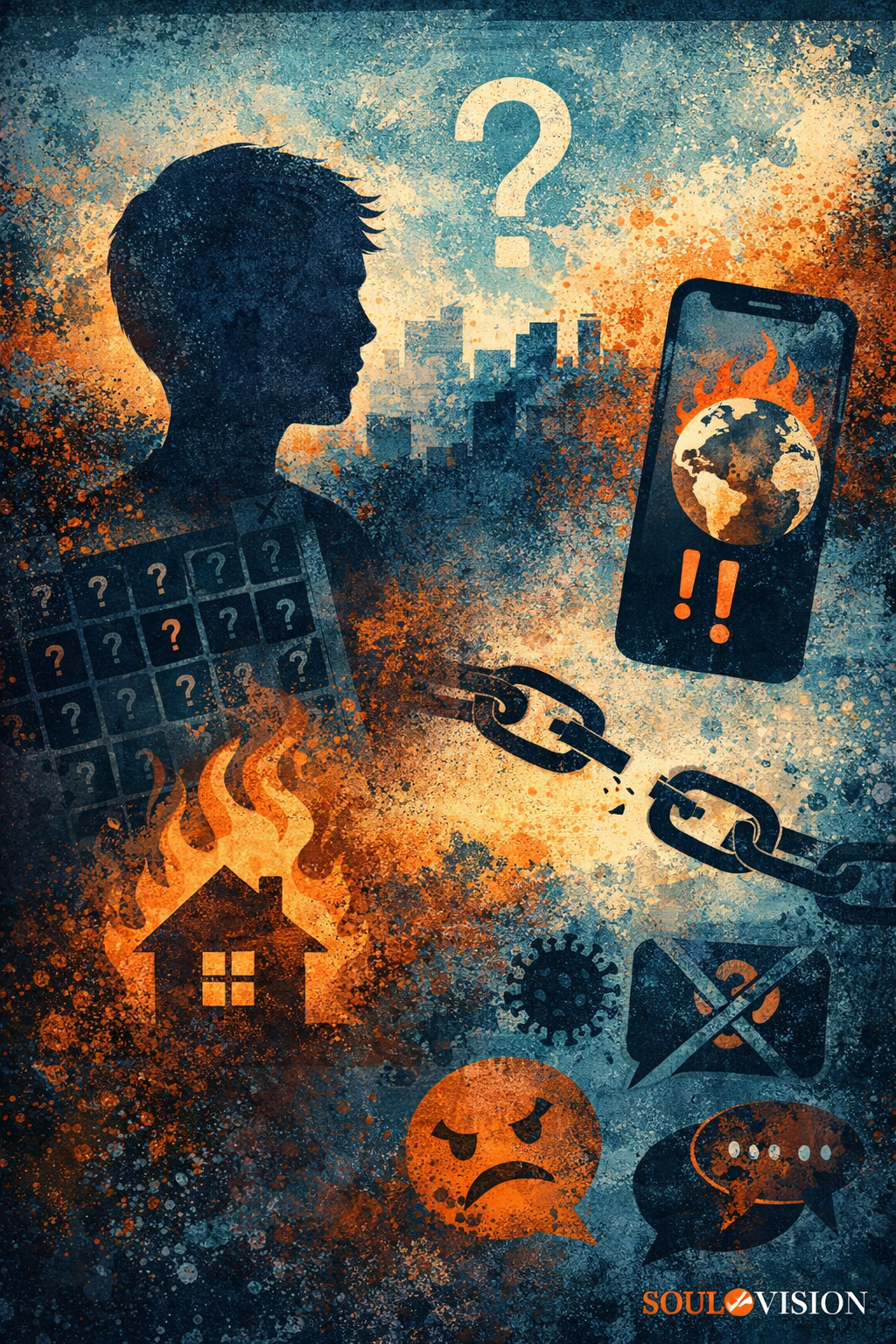


In our contemporary society, distrust, division, and instability are no longer distant concepts—they are lived realities, often marked by tragic situations that have involved young people and shaken entire communities. These moments disrupt any sense of normalcy, leaving us confused, fearful, and searching for understanding.
And too often, it does not unfold gradually or predictably. It happens suddenly—through acts of violence, conflict, or catastrophe that leave communities grieving and trying to make sense of what feels senseless.
But for many of our students and families, uncertainty isn’t reserved for those moments.
It is daily.
It lives in their homes, in their neighborhoods, in their conversations, and increasingly, in what they see and absorb every time they open a device.
And when both the sudden tragedies and the sustained uncertainty collide, schools are not on the sidelines.
They are on the front lines.
The Reality: Students Don’t Leave the World at the Door
When large-scale violence or instability occurs—whether domestic or global—students come to school carrying:
- Fear of what might happen next
- Confusion fueled by misinformation or incomplete narratives
- Personal connections to impacted communities
- Questions about safety, stability, and even morality
But even beyond those moments, many students are already navigating:
- Chronic uncertainty about their safety or future
- Exposure to ongoing conflict, division, or instability
- Family stress tied to economic, social, or political pressures
And increasingly, they are not hearing about these realities from adults first.
They are seeing them—uncurated, unfiltered, and often inaccurate—on their phones.
Which means by the time they arrive at school, the emotional impact has already begun.
Not just in crisis—but every day.
The First Responsibility: Stabilize Before You Explain
In moments of crisis—and in the midst of ongoing uncertainty—educators often feel pressure to have the “right words.”
But students don’t need perfect explanations first.
They need emotional stability and predictability.
That means:
- Acknowledging that something serious has happened—or that things feel uncertain
- Creating space for students to express what they are feeling
- Maintaining consistent routines where possible
- Avoiding speculation or unverified details
- Reinforcing that adults are present, attentive, and supportive
Before we teach content, we must establish psychological safety.
And for many students, that safety is built not just in what we say—but in what we consistently do.
The Second Responsibility: Lead With Truth—Without Causing Harm
Students will ask hard questions:
- Why did this happen?
- Are we safe?
- Could this happen here?
- Why does it feel like this keeps happening?
We cannot ignore these questions. But we also cannot answer them recklessly.
Effective responses are:
- Age-appropriate
- Fact-based (not rumor-driven)
- Grounded in what is known—and honest about what is not
It is okay to say:
“We are still learning more about what happened.”
or
“There are some things even adults are still trying to understand.”
What matters is that students hear calm, credible, and consistent messaging from trusted adults—especially when the world feels inconsistent.
The Third Responsibility: Anticipate Fear, Fatigue, and Retaliation Narratives
In the aftermath of violence—and in periods of ongoing tension—fear often evolves into:
- Blame
- Stereotyping
- Retaliatory language
- “Us vs. them” thinking
- Emotional fatigue and numbness
This is where schools must be intentional.
We must actively:
- Interrupt harmful narratives
- Reinforce the dignity and humanity of all people
- Monitor for bullying or targeted behavior
- Create structured opportunities for dialogue, not debate
- Recognize when students are overwhelmed—not just reactive
Because left unchecked, fear can become division.
And prolonged uncertainty can become disconnection.
The Fourth Responsibility: Prepare Staff—Not Just Students
Adults are not immune to fear—or fatigue.
Teachers, counselors, and staff members may also be:
- Processing their own emotions
- Carrying personal concerns about safety or stability
- Experiencing the weight of “always having to be steady”
School leaders must provide:
- Clear guidance on how to respond in classrooms
- Talking points or frameworks for discussion
- Permission to pause academic pacing if needed
- Space for staff to process and reset
- Access to support for staff well-being
We cannot expect adults to hold students steady if they feel unsteady themselves.
And we cannot sustain this work if we ignore the emotional toll on those doing it.
The Fifth Responsibility: Communicate Early and Often With Families
Silence creates space for speculation.
In moments of crisis—and in times of ongoing uncertainty—families are asking:
- What is the school saying to students?
- How are they being supported?
- Are they safe?
- How should we talk about this at home?
Proactive communication should:
- Acknowledge the moment or the ongoing concern
- Outline how the school is responding
- Provide guidance for conversations at home
- Reassure families about student safety and support systems
- Recognize that families themselves may be carrying fear or fatigue
Consistency between school and home matters more than ever in these moments.
The Deeper Truth: This Is the Work
We often talk about schools as places of learning.
But in moments like these—and in seasons of sustained uncertainty—schools become something more:
- Places of stability in an unstable world
- Places of healing
- Places of truth-telling
- Places where young people learn how to make sense of complexity—not just crisis
This is not separate from our mission.
This is the mission.
A Final Thought
We cannot predict every crisis.
And we cannot eliminate the uncertainty that many students live with every day.
But we can control how we show up.
Not just when the unthinkable happens—
but in the quiet, everyday moments when students are carrying more than we can see.
With consistency.
With compassion.
With courage.
Because in both crisis and uncertainty, students are watching to see if the adults in their lives can help them feel steady again.
And that is the kind of leadership they will remember.
