
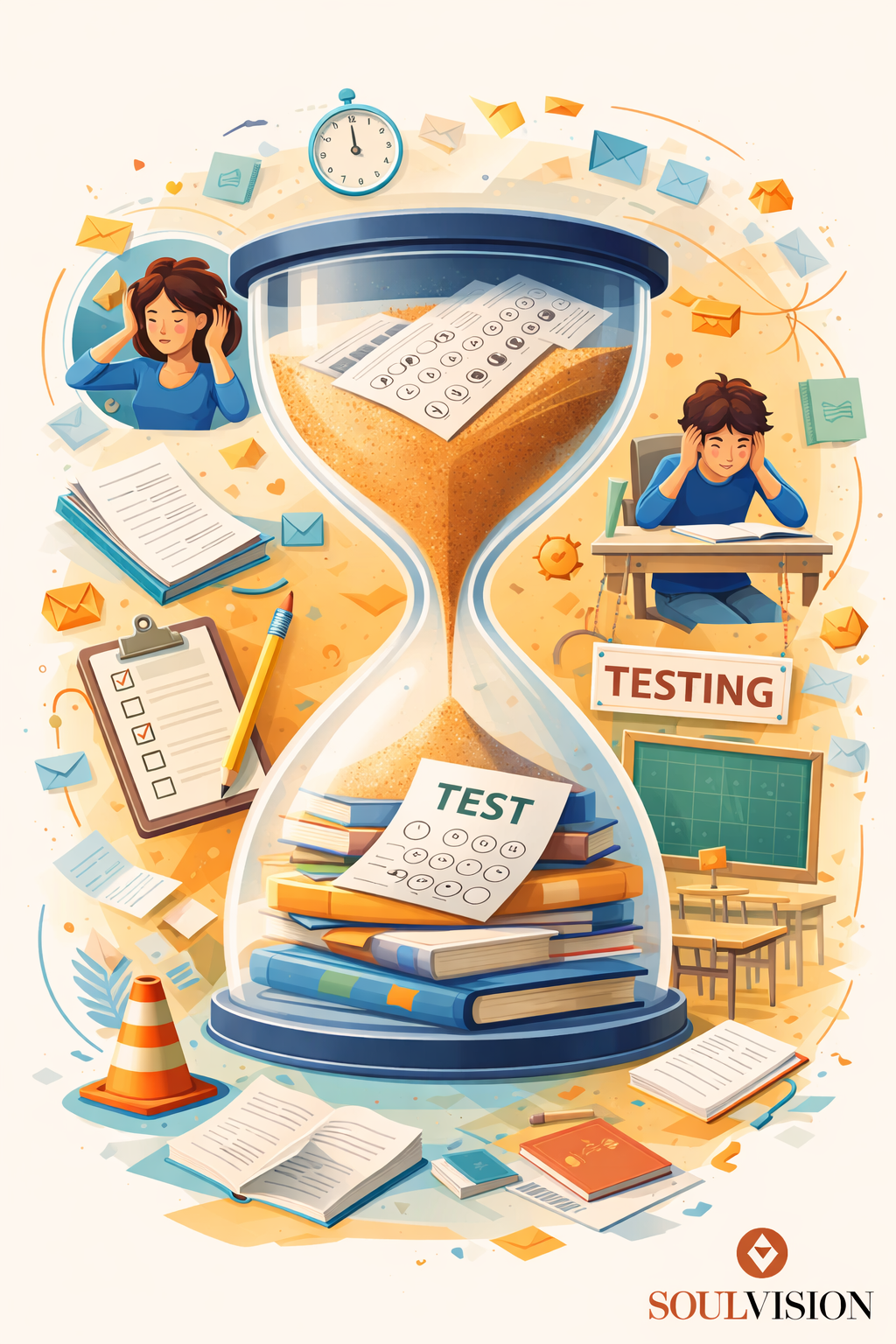


It is mid-April and all across the country, our public schools are currently deep in the throes of that predictable shift that happens each and every spring. Where instruction stops, drilling and prepping begin, and true learning comes to a halt.
The energy changes.
The schedule tightens.
The work narrows.
It’s testing season—and in too many classrooms, it quietly becomes the dominant force shaping what teaching and learning look like.
The Hidden Cost: Instructional Time Lost
On its face, standardized testing doesn’t seem that overwhelming. National estimates suggest students spend about 15–16 hours per year actually taking standardized tests in grades 3–8.
But that number tells only a fraction of the story.
Because testing is not just the hours spent taking the test—it is the ecosystem that surrounds it:
- Practice exams
- Test-taking strategy instruction
- Schedule disruptions
- Technology preparation
- Make-up testing windows
- Reduced instructional pacing before and after testing
When those are included, the loss becomes staggering.
Research has found that students can spend 80 to 100 hours per year on test preparation and related assessments—the equivalent of 16 to 20 full school days.
Other analyses suggest that, in practice, testing and preparation can consume nearly a quarter to a third of total instructional time in some classrooms.
Even more conservatively, standardized testing itself accounts for roughly 2–4 days of the school year, but the surrounding preparation stretches that footprint into weeks.
Let that settle for a moment:
We are asking teachers to prepare students for high-stakes assessments while simultaneously removing the very time needed to prepare them well.
And that raises a question we don’t ask nearly enough:
Is there any wonder that test scores across the country have either dropped or stagnated consistently?
Because the time that should be spent teaching and learning the content necessary for success on standardized tests—and in life—is instead consumed by preparing, rehearsing, and training for those same tests, rather than engaging in meaningful classroom instruction or providing the kind of deep, impactful educational experiences that drive student engagement, relevance, and genuine connection to learning.
We have created a system where preparation has replaced scholarship—and then we act surprised when outcomes fail to improve.
The Spring Reality: A System Under Pressure
This time of year—March through May—is where the tension peaks.
In schools across the country:
- Instruction is interrupted by rotating testing schedules
- Classrooms are converted into testing environments
- Specialists and administrators are pulled into proctoring roles
- Bell schedules shift, sometimes daily
- Teachers are expected to “stay on pace” while losing instructional blocks
And perhaps most critically:
Students feel it.
This pressure is not abstract. It shows up as:
- Fatigue
- Anxiety
- Disengagement
- Behavioral changes
Teachers feel it too—but in a different way.
They are navigating the contradiction of being held accountable for results while operating in conditions that actively undermine their ability to produce them.
The Instructional Paradox
Here is the paradox at the center of state testing:
The more pressure we place on outcomes, the more we distort the conditions required to achieve them.
Instruction thrives on:
- Continuity
- Depth
- Relationships
- Responsiveness
Testing season disrupts all four.
Instead of deep learning, we get repetition.
Instead of meaningful instruction, we get test rehearsal.
Instead of deep learning, we get compression.
Instead of responsiveness, we get rigidity.
Instead of continuity, we get fragmentation.
Instead of intellectual curiosity, we get compliance.
And over time, that shift doesn’t just affect test scores—it reshapes the culture of teaching itself.
What the Data (and Experience) Tell Us
We already know that time matters.
Research consistently shows that reductions in instructional time—even small ones—lead to measurable declines in student achievement.
So when we lose:
- Weeks to test prep
- Days to administration
- Hours to disruption
We are not just “pausing” learning.
We are diminishing it.
We say we are measuring student learning.
But in reality, we may be measuring something else:
- Endurance under pressure
- Familiarity with test formats
- Ability to navigate constrained conditions
Meanwhile, the work of deeper learning—critical thinking, problem solving, communication, collaboration, creativity, and application—gets pushed to the margins during the very months when it should matter most.
The Real Question We Should Be Asking
Accountability matters.
Data matters.
Understanding student progress matters.
But we have to ask a more honest question:
At what point does the pursuit of measurement begin to erode the very learning we are trying to measure?
Because right now, in many schools, we are not just assessing learning—we are crowding it out.
A Call for Balance
This is not a call to eliminate assessment.
It is a call to reclaim balance.
What would it look like if:
- Testing windows were shorter and less disruptive?
- Assessment systems prioritized instructional usefulness over compliance?
- Schools were evaluated using multiple measures—not just a single snapshot?
- We protected instructional time with the same urgency we protect testing integrity?
Because if we truly believe that teaching and learning are the core work of schools, then we must ensure that nothing—not even accountability—comes at their expense.
Final Thought
This is the quiet irony in education today:
We are measuring learning with increasing precision…
while steadily reducing the time and space needed for learning to occur.
And every spring, in our classrooms, teachers are left to navigate that contradiction—doing their best for students in a system that, at times, makes that work harder than it should be.
The question is not whether we need accountability.
The question is whether we are willing to design systems that honor both accountability and the integrity of instruction; whether we are willing to design systems that allow instruction—not testing—to drive outcomes.
Right now, the balance is off.
And our classrooms feel it.
Even more importantly, our kids are suffering and our schools are being judged by the wrong metrics. The system needs to be remade and our voices must rise to force legislators and policy makers to see the urgent need to allow educators to make educational decisions.
If we are serious about improving outcomes for students, then we have to be just as serious about protecting the time, space, and conditions that make real learning possible—because no system can test its way to success if it is undermining instruction in the process.
At some point, we have to decide what we value more: the appearance of accountability or the reality of learning—because right now, our system is asking schools to prove results while quietly taking away the very conditions needed to produce them.
