
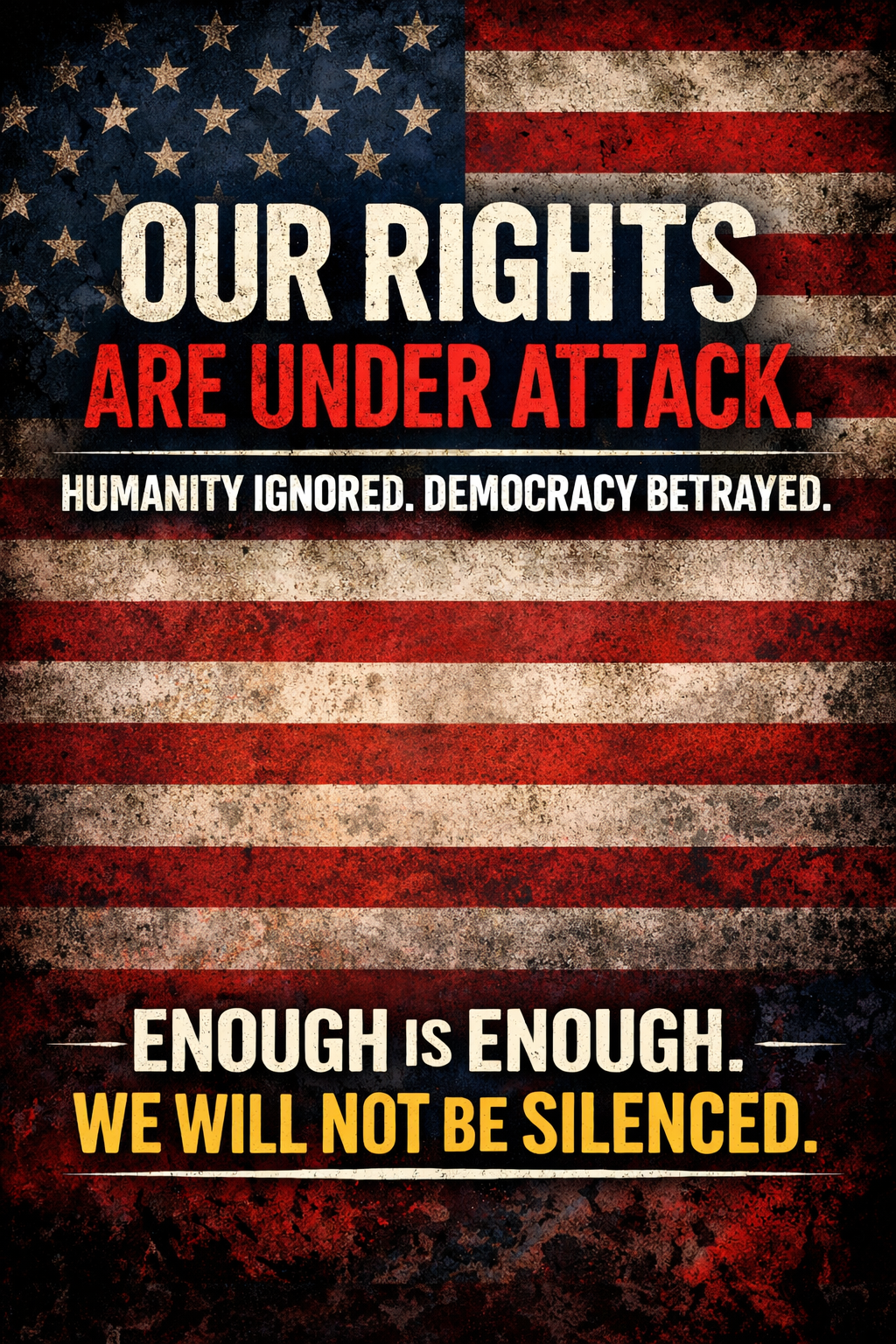


I am angry. Not in a fleeting, performative way—but in the kind of way that comes from watching a country repeatedly choose power over people.
We are living in a political moment that treats humanity as negotiable and rights as conditional. A moment where cruelty is repackaged as policy, where indifference is framed as pragmatism, and where the lives of real people are reduced to talking points and polls. The language has changed, but the outcome has not: those with the least power are asked to bear the greatest cost.
Our government increasingly ignores the basic dignity of human beings. It tramples civil liberties while claiming to protect “order.” It erodes democratic norms in the name of “security.” It uses our tax dollars not to safeguard communities, but to surveil, intimidate, and harm them—often with impunity. And when people raise their voices in protest, they are told to be patient, to be reasonable, to wait their turn while the ground beneath them disappears.
This is not leadership. This is abandonment.
What makes this moment especially dangerous is not just the policies themselves, but the normalization of them. We are being conditioned to accept the unacceptable—to see suffering as inevitable, to view injustice as unfortunate but necessary, to believe that rights are privileges granted by those in power rather than guarantees owed to every citizen.
I reject that.
Democracy is not merely the absence of a dictator. Freedom is not simply the ability to vote every few years. Citizenship is not obedience. A nation that silences dissent, threatens free elections, targets vulnerable communities, and enriches itself through fear is not a nation living up to its promise—it is a nation betraying it.
Outrage, in this moment, is not reckless. It is responsible. It is the natural response to witnessing moral failure at scale. The danger is not that people are angry. The danger is that too many are being asked to accept this as normal.
I refuse to do that.
History is watching us—not just in the sweeping moments, but in the quiet ones. In what we tolerate. In what we excuse. In what we choose to name. Silence has never protected democracy. Comfort has never advanced justice. And neutrality, in moments like this, only serves those already in power.
This country can be better. But it will not become better by accident. It will only change if enough people decide that humanity is not optional, that rights are not negotiable, and that democracy is worth defending—loudly, persistently, and without apology.
If this makes some people uncomfortable, so be it. Comfort has been prioritized long enough.
