


The Hard Choices Districts Must Make Before Scarcity Becomes the Strategy
All across the country, school districts are involved in a very important and impactful conversation.
It is happening in cabinet meetings, board work sessions, budget offices, union meetings, principal meetings, and communities.
We have to cut.
The financial pressures are real. Districts are confronting budget shortfalls, declining enrollment, rising operating costs, increasing student needs, aging facilities, and the end of pandemic-era relief funding.
So yes, many districts have to reduce spending.
But I believe we are asking the wrong question.
The question cannot simply be:
What can we cut?
The better question is:
What kind of school system are we trying to build?
Because there is an enormous difference between balancing a budget and building a better organization.
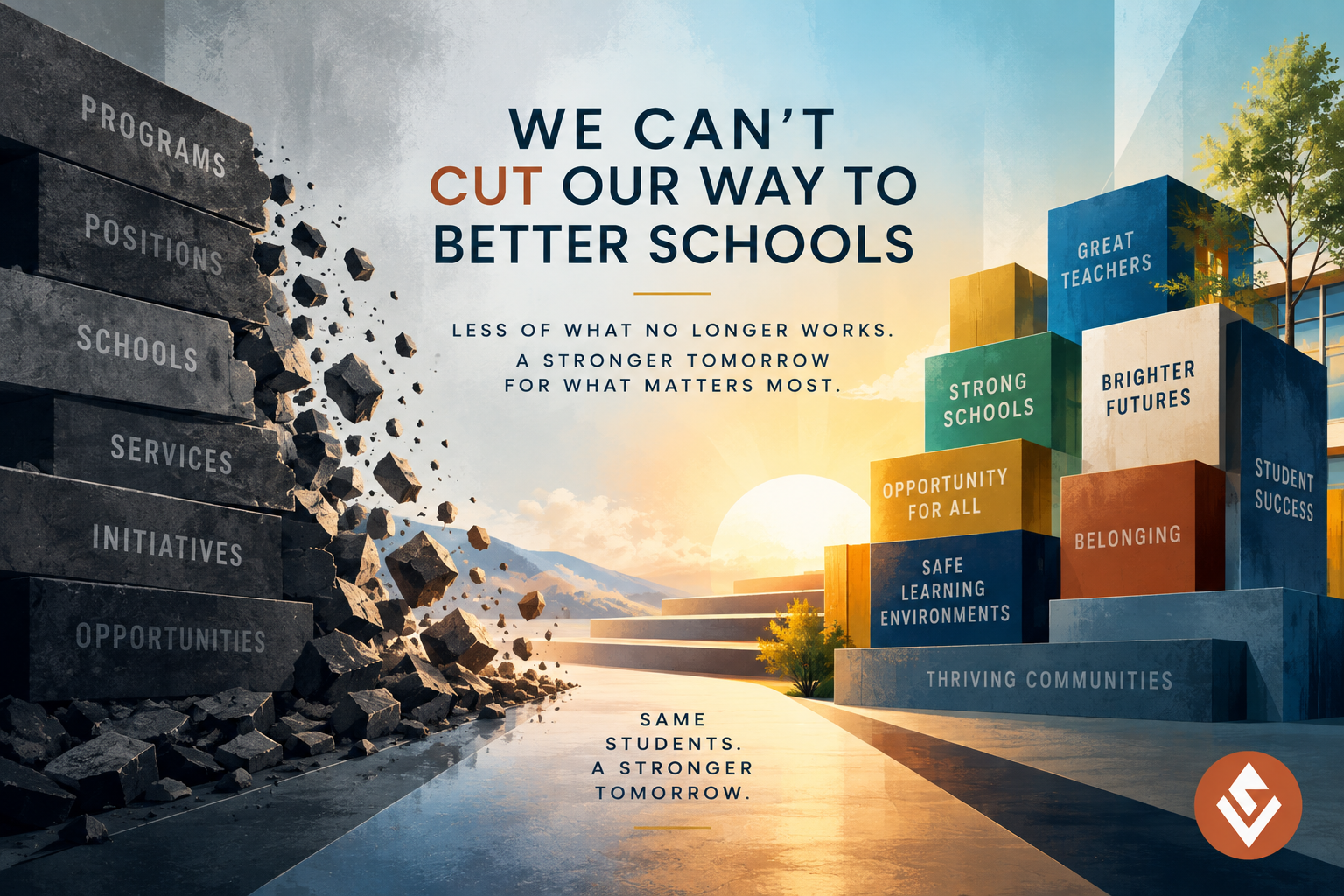
And we cannot cut our way to better schools.
Scarcity Should Force Clarity
When resources are plentiful, organizations accumulate.
Another program.
Another position.
Another initiative.
Another technology platform.
Another department.
Most were created for legitimate reasons. But over time, school systems can become collections of solutions created in different eras, by different leaders, for problems that may have changed—or disappeared.
Then resources become scarce.
Suddenly, we have to determine what actually matters.
That is painful.
But it can also be clarifying.
Scarcity should force us to identify what is essential.
Not what has existed the longest.
Not what has the strongest constituency.
Not what is politically easiest to protect.
What is essential to students, schools, and the mission.
Cutting Is Not a Strategy
There is a temptation during financial crises to celebrate the reductions themselves.
We eliminated this many positions.
Reduced central office by this percentage.
Cut this many millions of dollars.
Closed the gap.
Those numbers are obviously important because the decisions needed to be made. We all can concede that fiscal stewardship matters.
But a smaller organization is not automatically a better organization.
Cutting is not a strategy. Prioritizing is.
The real question is what remains after the reductions.
Did we protect great teaching?
Did we strengthen school leadership?
Did we preserve the capacity to improve learning?
Did we eliminate duplication?
Did we simplify processes?
Did we protect students requiring greater support?
Did we examine programs based on impact rather than history?
Most importantly:
Did the organization become more focused—or merely smaller?
If We Were Building This District Today, Would We Build It This Way?
This is one of the primary questions school systems most need to ask.
Forget for a moment the organizational chart we inherited.
Forget which programs have always existed.
Forget how departments have historically operated.
Imagine we were creating the district today.
Knowing what we now know about students, technology, artificial intelligence, workforce expectations, mental health, special education, transportation, enrollment, facilities, school choice, and family expectations:
Would we build the same system?
Would central office look the same?
Would every program still exist?
Would employees spend their time doing the same work?
Would teachers complete the same administrative tasks?
Would we purchase the same technology?
Would we operate every facility in the same way?
Would principals navigate the same bureaucracy?
Or are we trying to finance yesterday’s school system while asking educators to create tomorrow’s?
That question should make us uncomfortable.
The Classroom Cannot Be an Afterthought
Nearly every district says it wants to keep reductions as far away from the classroom as possible.
That is the right instinct.
But perhaps the better question is whether the organization was truly designed around the classroom in the first place.
Central office matters.
Transportation matters.
Human resources matters.
Technology matters.
Finance matters.
Facilities matter.
Student services matter.
But every part of the organization should be able to answer:
How does our work make schools more capable of serving children?
If teachers spend hours navigating processes created for administrative convenience, something is wrong.
If principals manage bureaucracy instead of leading instruction, something is wrong.
If schools struggle to access the resources they need because of organizational complexity, something is wrong.
Central office should not exist simply to administer a district.
It should exist to make schools better.
We Are Rarely Choosing Between Good and Bad
This is where leadership becomes difficult.
Every program has advocates.
Every position has a person attached to it.
Every school has history.
Every department can explain why its work matters.
And most are telling the truth.
We are rarely choosing between something valuable and something worthless.
We are often choosing between multiple valuable things when we can no longer afford all of them.
That is the weight.
Some decisions will be unpopular.
Some will generate headlines.
Some will create anger.
Some will affect people we know and respect.
We should never become numb to that.
But avoiding difficult decisions because they are politically uncomfortable is also a decision.
Eventually, someone pays for our unwillingness to choose.
Too often, that someone is a child.
Before We Eliminate, We Should Interrogate
Financial pressure should not give leaders permission to cut recklessly.
It should make us more disciplined.
Before eliminating something, ask:
What problem was this designed to solve?
Does that problem still exist?
Is this actually solving it?
Who benefits from it?
What happens if it disappears?
Could the work be accomplished differently?
Would we create this today if it did not already exist?
That last question matters.
Organizations often confuse familiarity with necessity.
They are not the same.
And the reverse is equally important: we should not eliminate something merely because its value is difficult to quantify on a spreadsheet. Some of the most important work schools do—relationships, belonging, safety, mentorship—requires us to exercise judgment alongside data.
This Is Bigger Than a Budget Problem
I believe the financial challenge confronting districts is actually an organizational challenge.
Money is forcing the conversation.
But the conversation is about more than money.
It is about relevance.
Effectiveness.
Priorities.
Structure.
Trust.
And courage.
This moment gives districts an opportunity to do more than survive another budget cycle.
Simplify.
Consolidate where appropriate.
Modernize.
Eliminate duplication.
Stop doing things that no longer work.
Invest more deeply in things that do.
Use technology differently.
Give educators back time.
Move decisions closer to schools when appropriate.
Align resources with the vision we claim to believe.
That is not simply cutting.
That is redesign.
Redesign Requires Vision
This is where leadership matters most.
“We need to save $100 million” is not a vision.
“We need to eliminate positions” is not a vision.
“We need to reduce central office” is not a vision.
Those may be necessary actions.
But people need to understand what exists on the other side.
What will schools become?
What will teachers experience differently?
What will students gain?
What are we protecting?
What are we building?
Why is the disruption worth it?
Without those answers, reductions simply feel like loss.
A compelling vision does not eliminate the pain of difficult decisions.
But it gives the sacrifice purpose.
What Are We Unwilling to Lose?
Perhaps every district facing scarcity should begin there.
Not with what we will cut.
But with those things that we refuse to compromise.
Great teaching.
Strong principals.
Safe and welcoming schools.
Rigorous learning.
Support for students who need more.
Opportunity.
Belonging.
Everything else should be examined in relation to those commitments.
Does this advance them?
Does it enable them?
Does it produce enough value to justify what it costs?
Because the purpose of a school district is not to preserve the school district.
The purpose is to serve children.
Those are not always the same thing.
A Final Reflection
The financial challenges facing public education are real.
But perhaps scarcity can force a conversation abundance allowed us to avoid.
Not:
What can we afford to keep?
But:
What are we trying to become?
Not:
How do we preserve the organization we have?
But:
What organization do our students actually need?
And perhaps the hardest question:
What can our children no longer afford for us to keep doing simply because we have always done it?
We cannot preserve every program, structure, position, initiative, or tradition.
Nor should we.
But we can protect what matters most.
We can align resources with our values.
We can make difficult decisions with humanity.
We can stop doing what no longer works.
And we can refuse to mistake smaller for better.
We cannot cut our way to better schools.
But we can use this moment to decide what a better school system should actually look like—
and then have the courage to build it.
