


I recently read a blog piece—“i-Ready: 13 Million Students, Zero Meaningful Evidence”—with both concern and recognition. Concern because of what it reveals. Recognition because, if I’m being honest, I’ve sat in those same rooms where decisions like this get made.
The article raises a provocative and necessary question: how does a tool used by over 13 million students—roughly one-third of America’s K–8 population—lack a strong, independent evidence base demonstrating meaningful impact on learning?
As a former superintendent, I don’t read that as an indictment of a single product. I read it as a mirror held up to the system.
THE REALITY OF DISTRICT DECISION-MAKING
In school systems, adoption rarely begins with “What does the research say?” It often begins with:
- What can we fund?
- What integrates easily with our current systems?
- What promises to solve multiple problems at once?
- What are neighboring districts using?
i-Ready—and platforms like it—fit that profile perfectly. It started as a diagnostic tool and evolved into a full instructional system. That evolution is exactly what districts are drawn to: efficiency, coherence, and the promise of personalization at scale.
But here’s the tension: scale and effectiveness are not the same thing.
THE EVIDENCE QUESTION WE DON’T ASK ENOUGH
The article points out a troubling gap—no randomized controlled trials, limited peer-reviewed research, and reliance on vendor-supported or lower-tier studies.
In any other sector—healthcare, aviation, engineering—this would stop adoption in its tracks.
In education, it often doesn’t.
Why?
Because we operate in a space where urgency outpaces patience. When students are behind, when teachers are overwhelmed, when boards are demanding solutions, leaders are pressured to act. And too often, we equate implementation with improvement.
I’ve been there. You want to do something—anything—that signals progress.
THE MOST IMPORTANT INSIGHT: WHERE LEARNING ACTUALLY HAPPENS
What struck me most in the article is not just the lack of evidence—it’s the critique of how these tools misunderstand learning itself.
The argument is clear: formative assessment works not because of the feedback given to students, but because of the insight it gives teachers to adjust instruction.
That distinction matters.
Because when systems shift the instructional decision making from educators to algorithms, we risk doing something dangerous:
We separate teaching from knowing the learner.
And no dashboard—no matter how sophisticated—can replace the moment a teacher recognizes confusion in a student’s eyes, adjusts in real time, and meets them where they are cognitively and emotionally.
That’s not nostalgia. That’s neuroscience and decades of research on effective instruction.
A HARD TRUTH FOR LEADERS
The article highlights a finding that should give every superintendent pause: even the most cited research shows minimal impact—no measurable gains in reading and marginal gains in math that may not be meaningful in practice.
But here’s the harder truth:
Even if the tool worked moderately well, the bigger question is whether it’s displacing something that works better.
- Is it replacing teacher-led small group instruction?
- Is it reducing opportunities for discourse, writing, and thinking?
- Is it narrowing learning to what can be measured on a screen?
Because opportunity cost in education is real—and often invisible.
THIS IS BIGGER THAN I-READY OR ANY OTHER TOOL
This is not about one program.
This is about a pattern:
- We adopt at scale before we validate at scale
- We trust branding over evidence
- We prioritize efficiency over instructional depth
- We mistake data generation for learning
And perhaps most importantly:
We look for tools to solve problems that require systems thinking and human capacity.
WHAT I WOULD SAY TO SUPERINTENDENTS RIGHT NOW
If I were back in the seat today, I wouldn’t start with, “Should we keep or remove i-Ready?”
I would start with better questions:
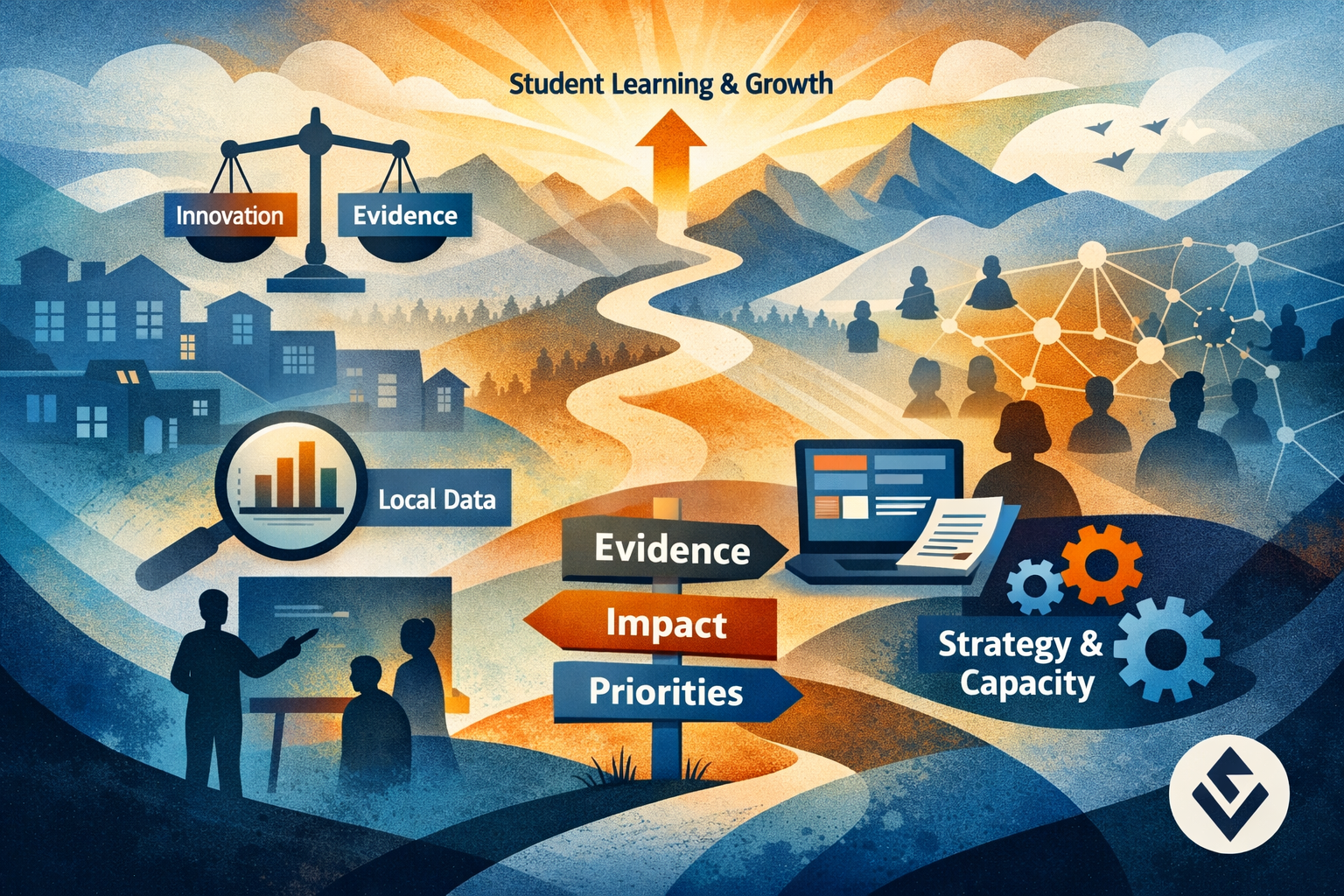
- What evidence do we have—independent of the vendor—that this is improving student outcomes in our context?
- How is this tool strengthening—not replacing—teacher decision making?
- What instructional practices are being amplified or diminished because of this?
- Are we investing as much in educator capacity as we are in digital tools?
Because no program—no matter how well designed—will outperform a skilled teacher equipped with deep knowledge of their students.
FINAL THOUGHT
Technology has an important role in education. That is very clear. It can accelerate, organize, and support. Again, my perspective is not an indictment of i-Ready or any one single product.
But it (they) cannot—and should not—replace the core engine of learning: the relationship between a teacher, a student, and the content they are wrestling with together.
When we forget that, we don’t just risk wasting money.
We risk wasting time.
And for the students sitting in our classrooms right now, that’s the one thing we cannot afford to lose.
